
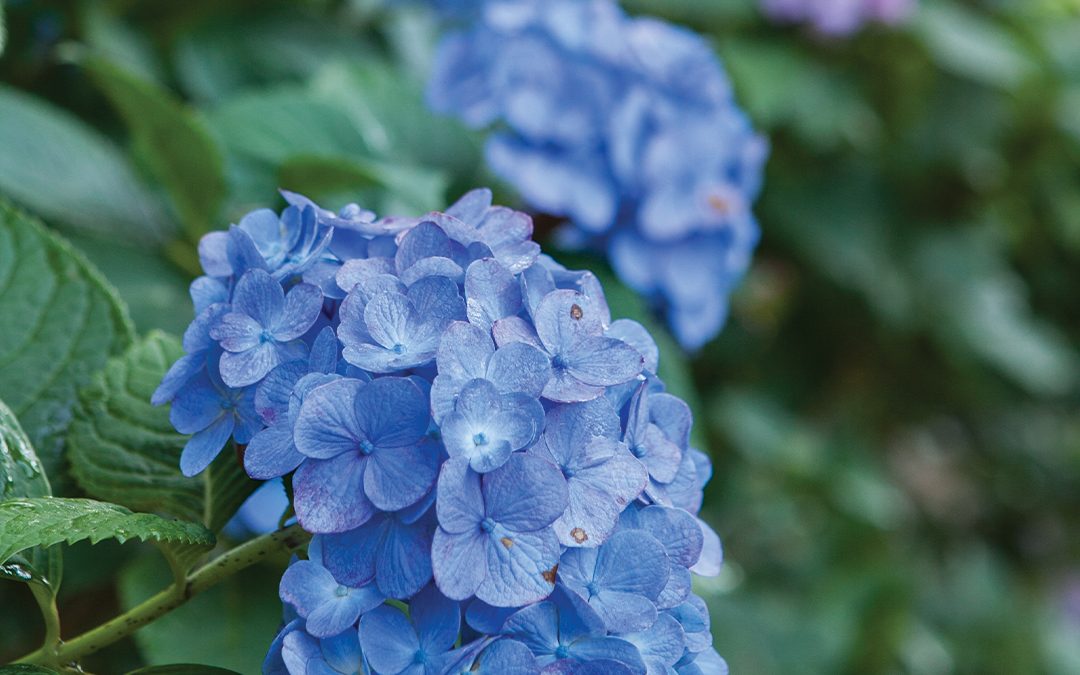
WHERE TO PLANT – Hydrangeas are shade-loving plants. Aren’t we always looking for plants that will grow in the shady part of the garden? However, be wary that too much shade can inhibit the number of blooms. Filtered light and partial shade seem to work best.
SOIL – Hydrangeas prefer moist, rich soil, so before planting, work in compost or well rotted manure. As most hydrangea enthusiasts know, acidic soil yields blue flowers, and alkaline soil yields pink flowers. If you want blue flowers, add aluminum sulphate. If you desire pink flowers, add lime. Some gardeners, with a mad scientist-like zeal, sometimes produce purple hydrangeas, but that is for those who majored in chemistry.
WATER – Hydrangea comes from the Greek word “hydor,” which means water, and from “angos,” which means water vessel. Hence, if you know your Greek, this is a shrub that needs a lot of water. Many garden experts recommend deep watering once a week, but when drought occurs and the temperature soars in a typical Mississippi summer, a more frequent watering schedule would be advisable. Keep hydrangeas well mulched. This will help them retain moisture during the long, hot summer. When hydrangeas get thirsty, the leaves tend to wilt. Get to know your shrubs.
FERTILIZER – Hydrangeas do not like to be overfed, and high-nitrogen fertilizers may even inhibit bloom. A slow-release or organic fertilizer applied in both the spring and fall is recommended by many experts, but some folks, who obviously have naturally good soil or luck, never apply fertilizer and still have gorgeous hydrangeas.
PRUNING – Ah, yes, pruning—this is about the only perplexing aspect regarding hydrangeas. Because there are new varieties of hydrangeas now, the time to prune tends to vary with the species. However, the rule of thumb is that hydrangeas that bloom on old growth should only be pruned after flowering, and hydrangeas that bloom on new growth should only be pruned in very early spring or as they are going dormant in the fall.